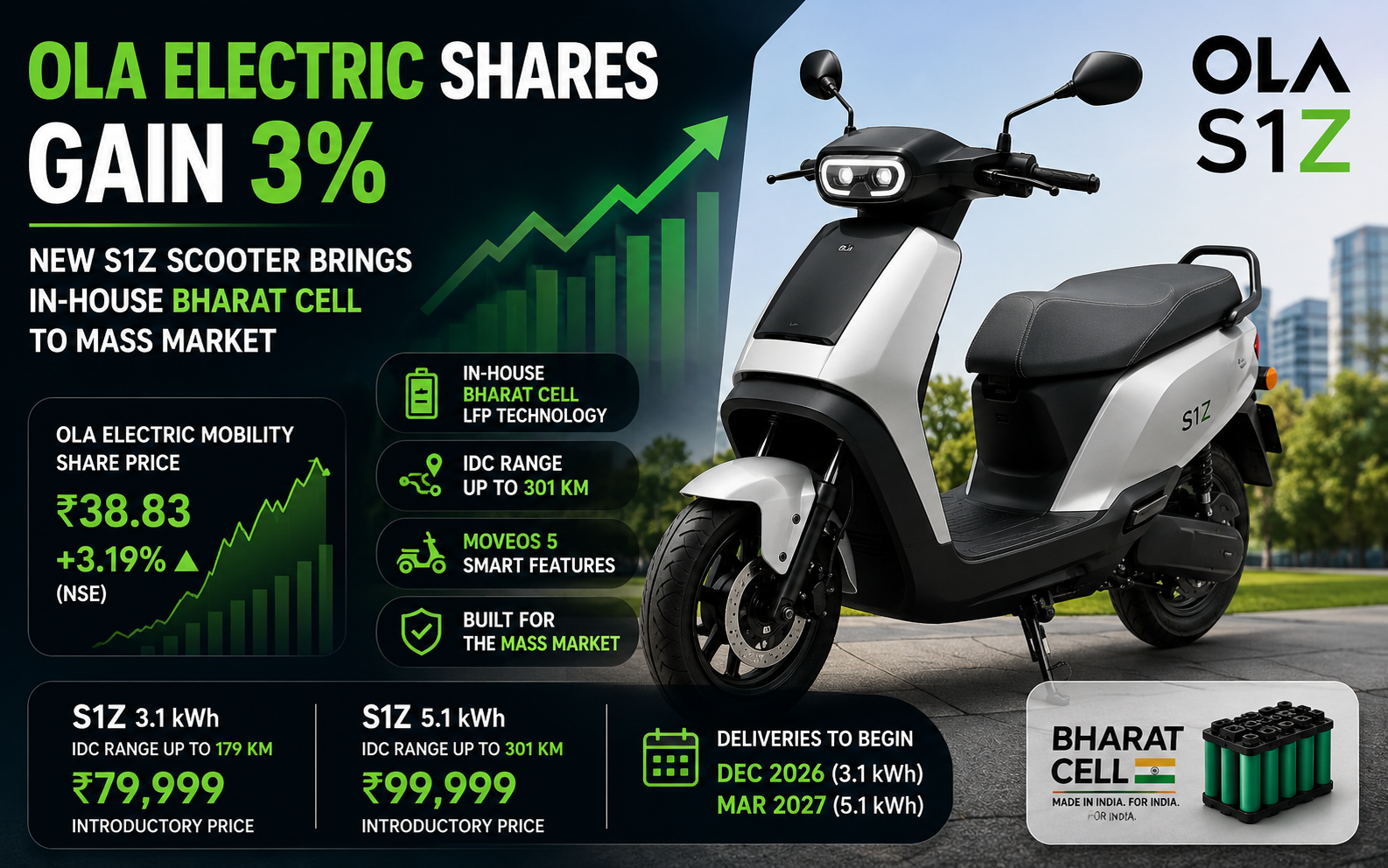
Ola Electric Shares Rise After S1Z Launch : Ola Electric shares attracted fresh attention after the company launched its new S1Z electric scooter range, bringing its locally developed Bharat Cell LFP battery technology to a more affordable part of the market. The product launch gave investors another reason to watch the EV maker as Ola continues its push to reduce dependence on externally sourced components.
On August 28, 2026, Ola Electric Mobility shares gained more than 3% during trading. The stock eventually closed at ₹38.83 on the NSE, up 3.19% for the day, according to market reports.
The market reaction came alongside the launch of the S1Z, which Ola is positioning as a mass-market electric scooter. The company is hoping that its in-house battery technology can help bring more competitive EV products to Indian buyers.
Why Ola Electric Shares Moved Higher
The S1Z launch was important for investors because it represents more than just another scooter.
Ola Electric has been working toward greater vertical integration, including development of its own battery cells, motors, software and other EV components. The S1Z is the company’s first scooter range to bring its Bharat Cell LFP technology into its more accessible product portfolio.
Battery cost is one of the biggest expenses in an electric vehicle. Ola believes producing its own cells can help lower costs and eventually make advanced battery technology available at more affordable prices.
That strategy could become particularly important in India’s mass-market electric two-wheeler segment, where purchase price remains one of the biggest factors for customers.
Ola S1Z Price Starts at ₹79,999
The new S1Z is available in two battery configurations.
| Variant | Battery | Claimed IDC Range | Introductory Price |
|---|---|---|---|
| Ola S1Z | 3.1 kWh | Up to 179 km | ₹79,999 |
| Ola S1Z | 5.1 kWh | Up to 301 km | ₹99,999 |
Both prices are introductory ex-showroom prices. The 3.1 kWh version is scheduled to begin deliveries in December 2026, while the larger 5.1 kWh version is expected to reach customers from March 2027.
The claimed IDC figures are particularly notable for a scooter positioned in this price range, although real-world range will naturally depend on riding conditions, speed, load, temperature and riding style.
What Is Bharat Cell Technology?
One of the biggest talking points around the S1Z is its battery.
Ola says its 46-series LFP Bharat Cell technology has been developed at its Battery Innovation Centre and manufactured at the company’s Gigafactory. The company has designed the cell technology as part of its broader vertically integrated EV strategy.
LFP, or lithium iron phosphate, is a battery chemistry widely used in electric vehicles because of its durability and thermal characteristics.
For Ola, bringing the technology into its mass-market scooter range is strategically significant. The company wants battery development to become an advantage rather than simply an area where it depends on outside suppliers.
S1Z Features and Technology
The S1Z is not being marketed purely on battery capacity.
The scooter gets MoveOS 5, Ola’s software platform, along with several connected features. These include GPS, OTA software updates, cruise control, reverse mode, regenerative braking and ride statistics.
The scooter also offers geo and time fencing, while the Ola Electric app provides additional information about riding and energy consumption. An Easy Park feature is designed to make manoeuvring in tight parking spaces easier.
This combination of hardware and software is important because affordable EV buyers increasingly expect connected features rather than a basic electric drivetrain alone.
A Bigger Push Into India’s Mass EV Market
The S1Z comes at an important time for Ola Electric.
The company has been trying to strengthen its position in India’s electric two-wheeler market, and the S1Z gives it a product aimed directly at a larger customer base.
Ola reported that its EV market share improved to 8.4% in the first quarter of FY27, compared with 5.1% in the preceding quarter, according to Moneycontrol’s report.
The company is also expanding its retail strategy. Alongside its company-owned network, Ola plans to use dealer-operated stores as part of its next phase of retail expansion.
That could help the company reach customers in markets where its existing retail presence has been more limited.
What the S1Z Means for Ola Electric
The S1Z could be an important product for Ola for one simple reason: volume.
Premium electric scooters can attract technology-focused buyers, but mass-market products have the potential to reach a much larger audience.
A starting price below ₹80,000, combined with a claimed 179 km range, puts the S1Z in a segment where buyers are likely to compare it closely with petrol scooters as well as competing electric models.
The larger 5.1 kWh version takes the proposition further with a claimed 301 km IDC range and a ₹99,999 introductory price.
The challenge will be turning specifications into a strong ownership experience. Real-world range, charging convenience, after-sales service and long-term battery performance will ultimately matter as much as the headline numbers.
Ola Electric Stock: What Investors Should Watch
The rise in Ola Electric shares following the S1Z announcement shows that investors are paying attention to the company’s product and technology strategy.
However, a one-day stock move should not be interpreted as proof that the company’s long-term business outlook has changed.
Investors will likely continue watching deliveries, margins, market share, production efficiency and customer demand. The company’s ability to scale its own battery technology while keeping costs under control could also become an important factor.
Ola Electric shares have experienced significant volatility, so the S1Z launch should be viewed as one development within the company’s broader turnaround and expansion story.
Final Take
The Ola S1Z is more important than a routine new scooter launch. It represents Ola Electric’s attempt to bring its in-house Bharat Cell LFP technology into the mass market while keeping the starting price at ₹79,999.
The combination of a locally developed battery platform, connected software, competitive claimed range and a lower entry price gives the S1Z an interesting position in India’s growing EV market.
For investors, the immediate positive reaction in Ola Electric shares shows that the launch has generated market interest. For customers, however, the real test will begin when deliveries start and the scooter gets into the hands of everyday riders.
If Ola can deliver the promised range, reliability and ownership experience at the announced prices, the S1Z could become an important step in the company’s effort to make electric mobility more accessible in India.
What is the starting price of the Ola S1Z?
The Ola S1Z starts at an introductory ₹79,999 ex-showroom for the 3.1 kWh version. The 5.1 kWh model is priced at ₹99,999 ex-showroom.
What is the range of the Ola S1Z?
The 3.1 kWh version has a claimed IDC range of up to 179 km, while the 5.1 kWh version claims up to 301 km.
What is Bharat Cell in the Ola S1Z?
Bharat Cell refers to Ola Electric’s in-house LFP battery-cell technology. The company says the technology is developed at its Battery Innovation Centre and manufactured at its Gigafactory.
When will Ola S1Z deliveries start?
Deliveries of the 3.1 kWh version are scheduled to start in December 2026, while the 5.1 kWh version is expected from March 2027.
Why did Ola Electric shares rise?
Ola Electric shares gained more than 3% on August 28 following the S1Z launch and the company’s introduction of in-house Bharat Cell technology to its mass-market scooter range. The stock closed at ₹38.83 on the NSE, up 3.19%.