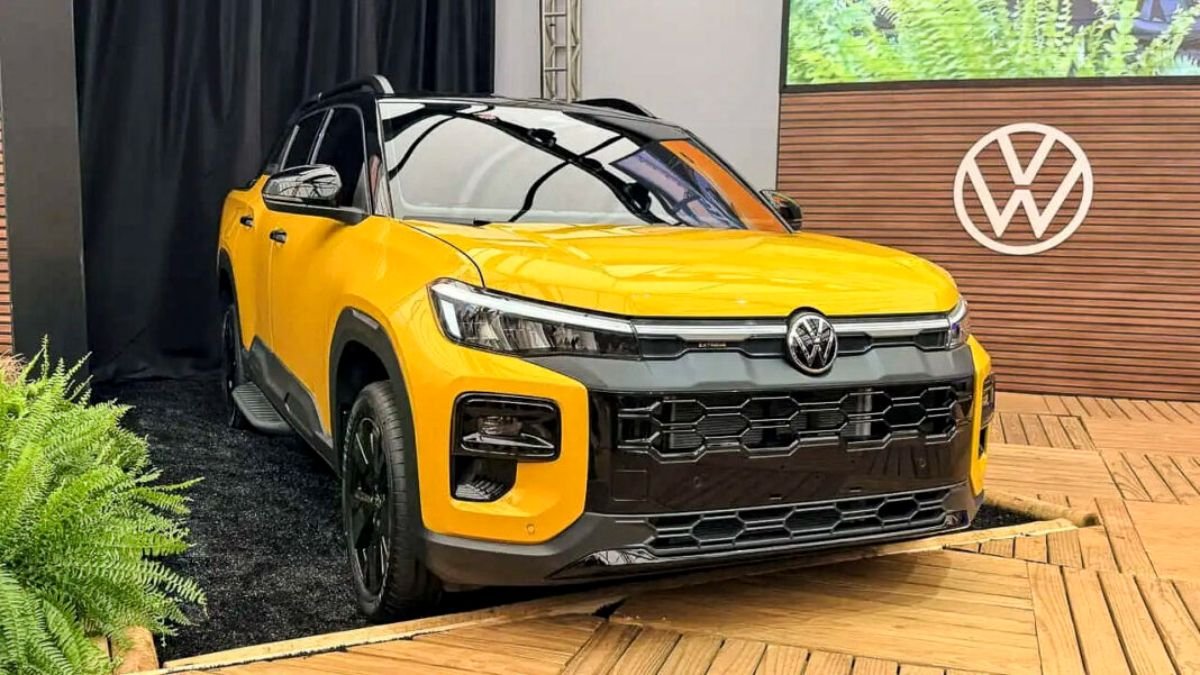
new Volkswagen Tukan pickup has made its global debut in Brazil, giving us the clearest Vw tukan look yet at Volkswagen’s upcoming pickup for the Latin American market. The truck was shown publicly at the Festa do Peão de Barretos in São Paulo, where Volkswagen displayed both single-cab and double-cab versions.
The Tukan is scheduled to arrive in Brazil in the first half of 2027, with production planned at Volkswagen’s São José dos Pinhais plant in Paraná. The pickup is part of Volkswagen’s wider product offensive in South America and has been developed specifically with the region’s roads, customers and market requirements in mind.
A New Chapter for Volkswagen’s Pickup Range
The Tukan represents a new direction for Volkswagen in the compact and midsize pickup space. The company already sells the Saveiro and Amarok, but the Tukan is designed to occupy a different position between Volkswagen’s smaller utility pickup and larger trucks.
Volkswagen says the project was designed, planned and developed in Brazil, making local engineering a major part of the vehicle’s identity. The company has invested heavily in its South American operations as part of a plan to introduce 21 new products in the region by 2028.
Although the Tukan has sometimes been described as a Saveiro replacement, Volkswagen itself is currently presenting it as a pickup for a new segment within its lineup, rather than officially calling it a direct replacement.
Bold and Rugged Exterior Design
The production-ready Tukan has a strong road presence. Its front end is tall and upright, giving the pickup a more substantial appearance than the outgoing Saveiro.
The front features slim LED lighting elements connected visually by a horizontal design detail, with the Volkswagen badge positioned in the centre. A broad grille and sharply defined bonnet lines add to the truck’s rugged character.
Along the sides, the Tukan gets squared-off wheel arches, protective body cladding and practical side steps. The double-cab version has a more lifestyle-oriented appearance, while the single-cab model puts greater emphasis on utility and cargo space.
At the back, vertically arranged tail lamps and large TUKAN lettering on the tailgate give the pickup a distinctive identity. The tailgate also incorporates a stepped bumper area designed to make access to the cargo bed easier.
Single-Cab and Double-Cab Versions
One of the most important aspects of the new pickup is its two body configurations.
The single-cab Tukan is aimed more directly at commercial users, small businesses and customers who prioritise cargo capacity. With fewer passenger seats, this version can devote more space to the load area.
The double-cab Tukan, meanwhile, is expected to appeal to private buyers and customers who want a pickup that can be used for both work and everyday driving.
This two-version strategy gives Volkswagen the flexibility to compete across a wider part of the Brazilian pickup market.
MQB Platform Gets Pickup-Specific Changes
Under the skin, the Tukan uses Volkswagen’s MQB architecture, a platform family already found underneath several Volkswagen models.
However, Volkswagen has made significant changes to make the architecture suitable for pickup duty. The Tukan uses a rigid rear axle with leaf springs, a traditional solution for vehicles that need to carry loads and deal with rough road conditions.
According to Volkswagen, the Tukan is the first vehicle using the MQB architecture to combine it with this type of rear suspension. The setup is intended to provide durability and strong load-carrying ability while keeping the vehicle suitable for everyday use.
This is an important distinction because the Tukan is not simply a passenger vehicle converted into a pickup. Its chassis and suspension have been developed around the requirements of a utility vehicle.
Engine Options and Performance
Volkswagen has not yet released the complete production powertrain range, so some engine details remain subject to final confirmation.
Current reports indicate that the Tukan could receive several engine options, allowing Volkswagen to cover both entry-level commercial versions and more powerful, better-equipped variants.
Reported possibilities include a 1.6-litre naturally aspirated engine, a 1.0-litre turbocharged engine and the familiar 1.4 TSI in some versions. Higher variants are expected to use Volkswagen’s newer 1.5 TSI Evo2 mild-hybrid technology.
The mild-hybrid version could become one of the most interesting parts of the Tukan range because it would combine turbocharged performance with improved efficiency.
However, Volkswagen has not yet announced final horsepower, torque, acceleration or fuel-economy figures for every version.
Practicality Will Be a Major Strength
A pickup has to do more than look tough, and Volkswagen appears to understand that.
The Tukan’s leaf-spring rear suspension is designed around carrying loads, while the single-cab version provides a larger cargo area. Reports indicate that the pickup could offer more than 700 kg of payload, although final specifications and configurations still need to be confirmed.
For buyers who use their vehicle for work during the week and personal travel at the weekend, the double-cab model could provide a useful compromise.
Technology and Interior
Volkswagen has not yet revealed every detail of the Tukan’s production interior, but the company is expected to give the new pickup a more modern cabin than traditional work-focused trucks.
Higher versions are expected to receive a digital instrument display, touchscreen connectivity and modern safety technology. The double-cab model should receive the more comprehensive equipment package.
The goal appears to be straightforward: make the Tukan capable enough for work without making it feel basic when used as an everyday family vehicle.
Volkswagen Tukan Expected Specifications
| Specification | Details |
|---|---|
| Model | Volkswagen Tukan |
| Model Year | 2027 |
| Global Debut | Brazil |
| Market Launch | First half of 2027 |
| Body Styles | Single Cab and Double Cab |
| Architecture | Volkswagen MQB |
| Rear Suspension | Rigid axle with leaf springs |
| Production Plant | São José dos Pinhais, Brazil |
| Powertrains | Multiple options expected |
| Hybrid Technology | 1.5 TSI mild-hybrid expected |
| Cargo Focus | Work and lifestyle use |
| Main Rivals | Fiat Toro, Chevrolet Montana and Fiat Strada |
Final engine output, dimensions, pricing and complete equipment levels are still to be announced.
Volkswagen Tukan vs Fiat Toro
The Fiat Toro will be one of the most important vehicles in the Tukan’s sights.
The Toro has become popular by combining pickup practicality with SUV-like comfort. Volkswagen is taking a similar broad approach, but the Tukan brings a newer MQB-based architecture and a strong focus on local development.
The availability of both single-cab and double-cab versions could also give Volkswagen an advantage among customers with very different needs.
Volkswagen Tukan vs Chevrolet Montana
The Chevrolet Montana is another important competitor. Like the Tukan, it targets buyers who want something more comfortable and modern than a traditional small work pickup.
Volkswagen will need to get the Tukan’s pricing right if it wants to challenge established rivals. Its engine choices, fuel economy, payload capacity and standard equipment will also play a major role in determining how competitive it becomes.
When Will the Volkswagen Tukan Go on Sale?
Volkswagen has confirmed that the Tukan will reach the Brazilian market in the first half of 2027. Production will take place at the company’s São José dos Pinhais facility in Paraná.
The exact launch date and pricing have not yet been announced.
Volkswagen is expected to reveal additional information closer to the commercial launch, including detailed specifications, trim levels and final powertrain configurations.
Will the Tukan Be Sold Outside Brazil?
The Tukan has been developed primarily for Brazil and Latin America, and Volkswagen has described it as a regional project with potential beyond the region.
Earlier comments from Volkswagen indicated that other countries had shown interest in the pickup. However, there is currently no confirmed global rollout plan, so buyers outside Latin America should wait for official market announcements.
Final Verdict
The Volkswagen Tukan has arrived as a completely new pickup designed around the needs of the Latin American market. Its global debut in Brazil gives us a much clearer picture of what Volkswagen has been developing behind the camouflage.
The combination of rugged styling, single- and double-cab body styles, MQB architecture and leaf-spring rear suspension gives the Tukan a strong practical foundation. The expected availability of a 1.5 TSI mild-hybrid powertrain could also give the pickup a modern edge in terms of performance and efficiency.
The biggest unanswered questions are still price, final engine specifications, payload, fuel economy and equipment levels. Those details will ultimately determine how successfully the Tukan can challenge established pickups such as the Fiat Toro and Chevrolet Montana.
With sales scheduled for the first half of 2027, the Tukan is shaping up to be one of Volkswagen’s most important new vehicles for Brazil and the wider Latin American market.